Ships as Infrastructure: What the 2026 Data Shows About a Private-Market Asset Class
Infrastructure is one of the fastest-growing asset classes in private-market fundraising, valued for essential services and steady, long-term income. Ships carry most of the world's trade and, when employed on long-term contracts, share those traits. This piece updates the case for shipping as part of the infrastructure asset class and what it means for private-market investors.
Devanshee Kothari
Growth and Research Manager
Published
October 21, 2026
In August 2025, we wrote in Shipping as Infrastructure Asset Class that shipping is increasingly considered part of the infrastructure asset class: ships carry essential cargo, they can earn long-term contracted income, and definitions of infrastructure are widening beyond assets fixed in place. A year on, 2026 research from J.P. Morgan, McKinsey and DNV puts firmer numbers behind that case and shows why it matters for private-market investors.
What makes an asset infrastructure
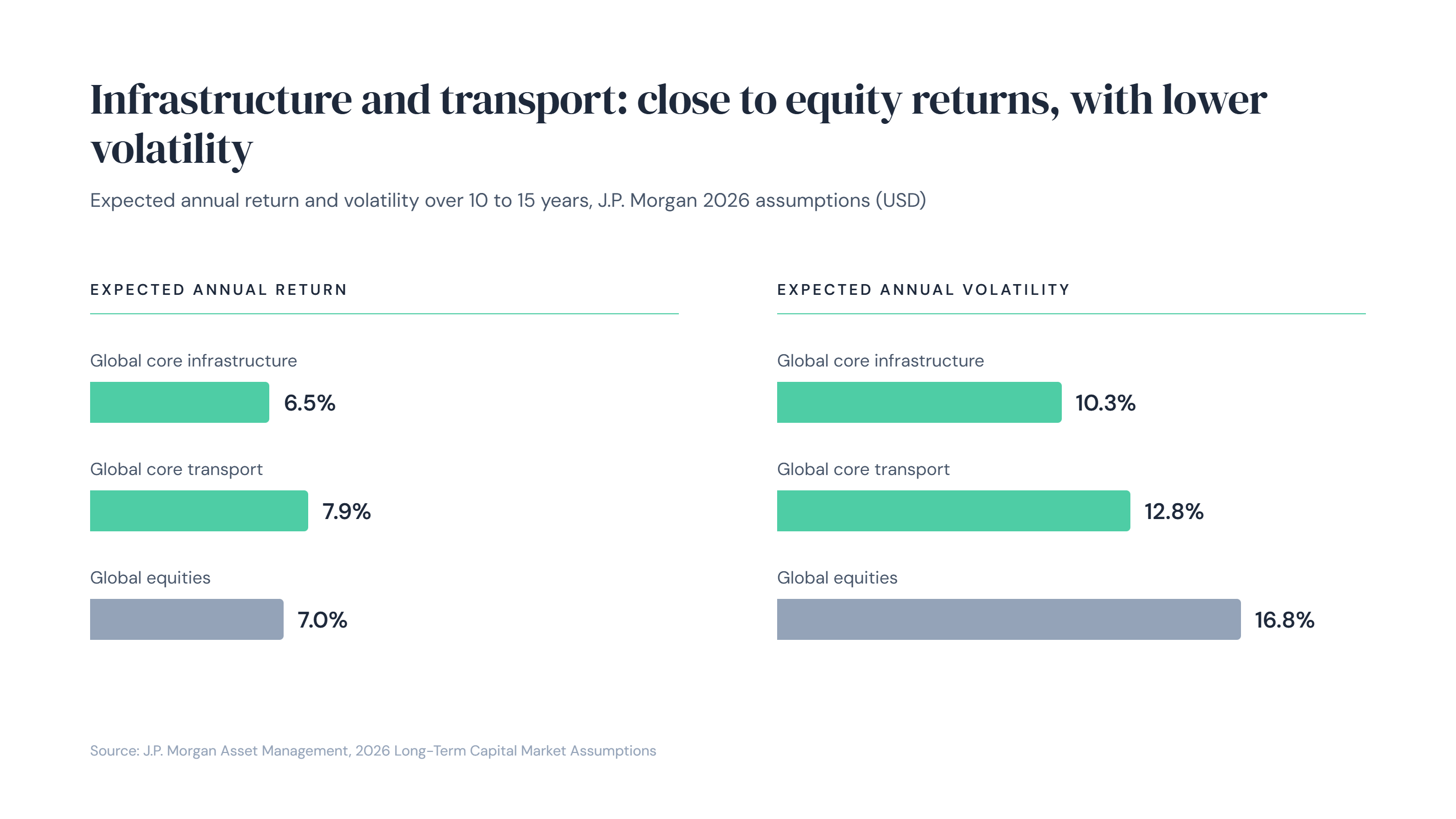
Infrastructure assets provide services an economy cannot run without. They last for decades, and they tend to earn steady income, often under long-term contracts. J.P. Morgan Asset Management's 2026 Long-Term Capital Market Assumptions project a 6.5% annual return for global core infrastructure over the next 10 to 15 years, which J.P. Morgan attributes to the essential nature of the services the asset class provides.
That income profile also shows up in risk. J.P. Morgan expects core infrastructure to carry volatility of about 10%, against nearly 17% for global equities, which it expects to return 7.0% a year. On these assumptions, infrastructure is expected to earn close to an equity return with almost 40% lower volatility.
Where ships fit
More than 80% of world trade moves by sea, according to UNCTAD's Review of Maritime Transport 2025. Ships carry the energy, food and raw materials economies depend on, which is the essential function that defines infrastructure. Infrastructure was traditionally defined by fixed assets such as roads and ports, and a ship moves. Our 2025 analysis argued that function, revenue stability and contribution to economic continuity matter more than whether an asset stays in one place.
The contract decides whether a ship behaves like infrastructure. A vessel employed on a long-term time charter earns an agreed daily rate for being available to the charterer, whatever happens to short-term freight rates. A vessel trading on the spot market earns whatever the market pays at the time, which makes it a more cyclical investment.
J.P. Morgan's 2026 assumptions list transport, the category ships belong to, as its own line next to core infrastructure, with a projected annual return of 7.9% and volatility of about 13%. J.P. Morgan also assumes a slightly negative correlation between transport and global equities (-0.11) and between transport and private equity (-0.21). Core infrastructure, by comparison, has an assumed correlation of 0.55 with global equities. Transport is the only alternative asset in J.P. Morgan's assumptions with a negative expected correlation to global equities, which makes it a diversifier in a multi-asset portfolio.
Infrastructure's place in private markets
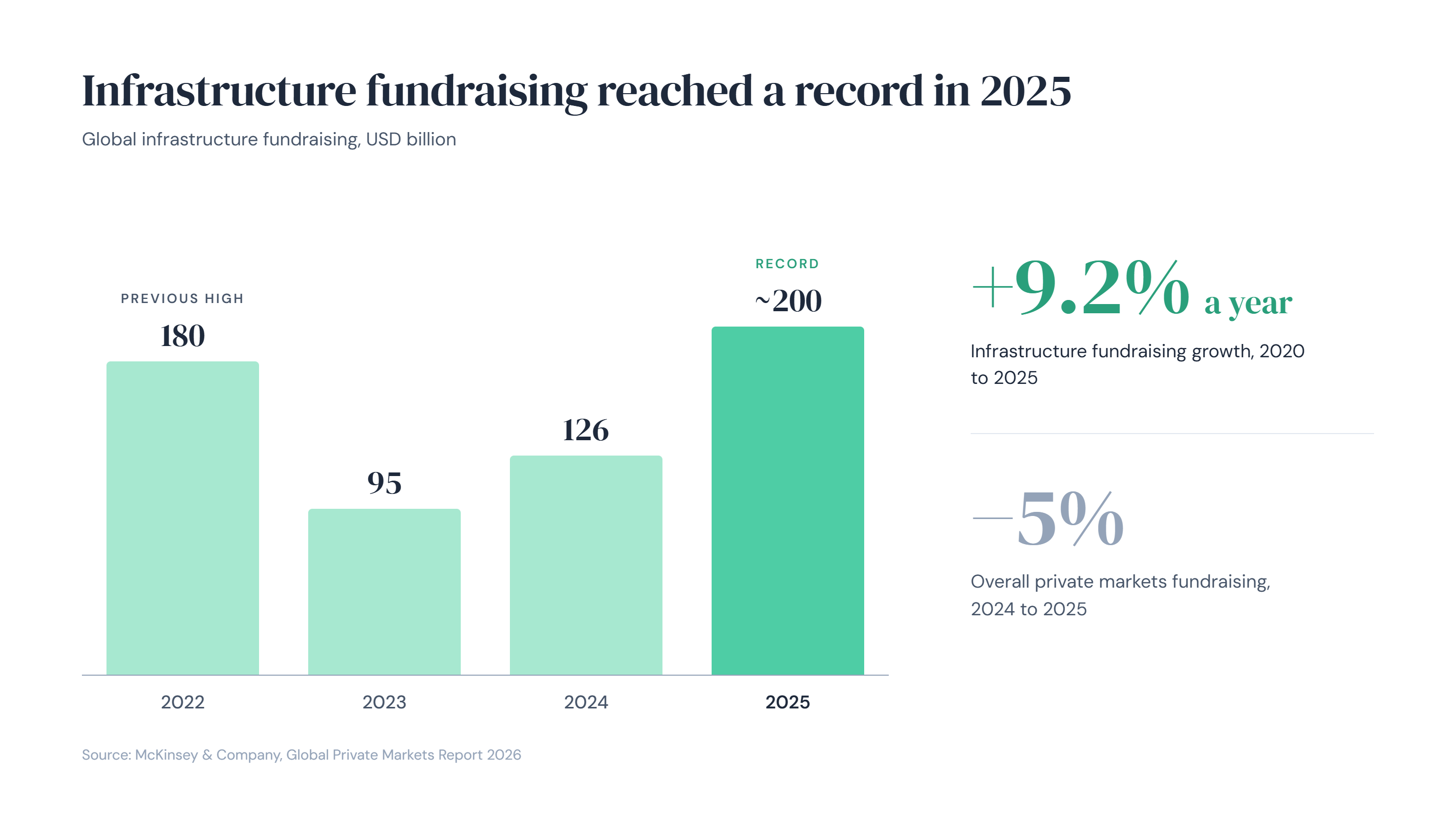
Investors have been moving into the asset class. In 2025, global infrastructure fundraising reached a record of nearly USD 200 billion, surpassing the previous high of USD 180 billion set in 2022, according to McKinsey's Global Private Markets Report 2026. Infrastructure fundraising grew at a 9% annual rate from 2020 to 2025, while other private-market asset classes saw declines of about 3% to 5%. McKinsey notes that limited partners are increasingly including infrastructure in their core strategies.
This is a private-markets asset class by nature. J.P. Morgan notes that alternative asset classes, including transportation and infrastructure, have no underlying investible index. Investors reach them through private funds, managers and direct holdings rather than an index fund.
A fleet due for renewal
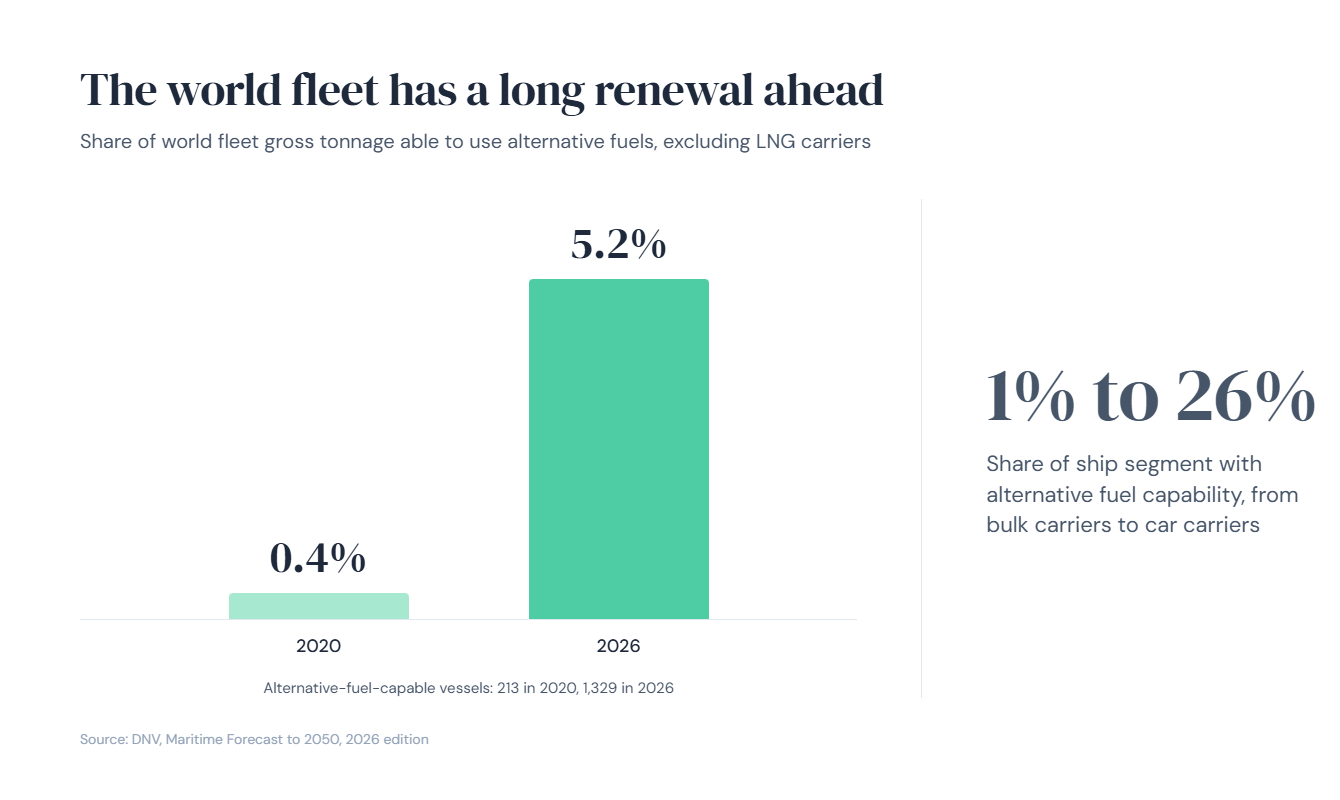
Ships also have to be replaced, and the world fleet has a long renewal ahead. DNV's Maritime Forecast to 2050, 2026 edition, finds that the share of the global fleet's gross tonnage able to run on alternative fuels rose from 0.4% in 2020 to 5.2% by August 2026, excluding LNG carriers. The number of such vessels grew from 213 to 1,329 over the same period. Even so, DNV estimates that 89.8% of the gross tonnage in operation today can run only on oil-based fuels.
Every replacement vessel is a long-life asset built to operate for decades, and renewing the fleet will take long-term capital, the kind that infrastructure investors provide.
What it means for private-market investors
The 2026 data describes an asset class with an essential function, income that can be tied to long-term contracts, expected returns close to equities with lower volatility and, in the case of transport, a negative expected correlation with the stock market. It is also an asset class reached almost entirely through private markets.
Private wealth still holds little of it. J.P. Morgan Private Bank's 2026 Global Family Office Report shows that most family offices have no infrastructure allocation at all. Our 2025 piece, Building the Future: Infrastructure as a Key Private Asset in Wealth Strategies, looked at why the asset class suits long-term private capital. For family offices and other professional investors, the question now is access: holding sizes, structures and liquidity options that fit a private portfolio.